
AI can make creative work dramatically faster. But when does efficiency strengthen a brand — and when does it start replacing the human judgment that made the brand distinctive?
AI is becoming extraordinarily good at making things faster. But speed and brand value are not the same thing.
That distinction is becoming one of the most important questions in modern marketing.
In 2025, The Coca-Cola Company introduced Project Fizzion, an AI-supported design system developed with Adobe. Its purpose is fascinating: turn established brand guidelines into an intelligent system that can help creative teams produce localized, on-brand assets faster. Coca-Cola says the system can accelerate some creative production by as much as ten times while keeping designers in control.
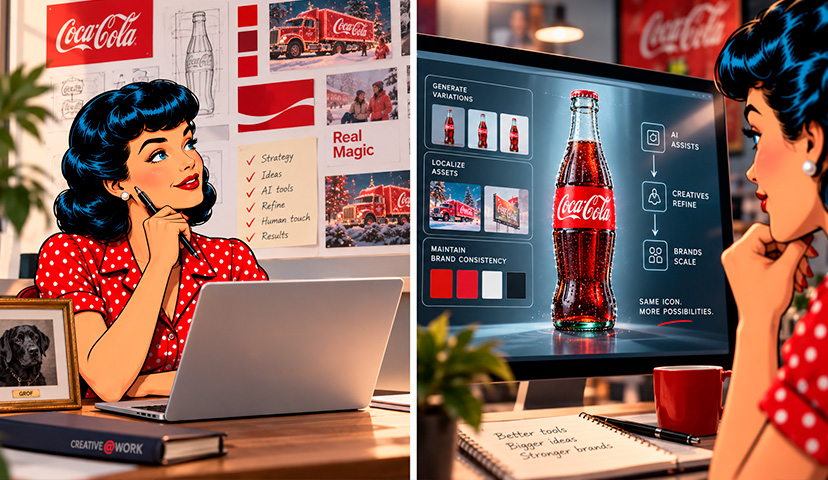
Around the same period, Coca-Cola also pushed generative AI much further into something consumers could actually see: its famous Christmas advertising.
The reaction was very different.
And somewhere between those two experiments lies an important lesson for every business using AI today:
AI may be most valuable when it makes creativity faster — not when it tries to become the creativity.
The AI Question Has Changed
A few years ago, businesses were asking:
Should we use AI?
In 2026, that question already feels outdated.
Creative professionals are using it.
Adobe’s research found that 99% of surveyed creative professionals were using generative AI in some capacity, with 88% saying it helped them produce content faster. AI is being used across ideation, production and post-production rather than simply to generate finished images.
The more useful question now is:
Which parts of the creative process should AI handle — and which parts should remain deliberately human?
For branding, that distinction matters enormously.
Because a brand is not simply a collection of correctly positioned logos, colours, fonts and images.
A brand is accumulated recognition. It is memory. It is expectation.
And, eventually, it becomes an emotional shortcut in someone’s mind.
That cannot simply be prompted into existence.
Coca-Cola Gives Us Two Very Different AI Case Studies
Coca-Cola is an especially interesting brand to watch because few companies possess stronger visual memory.
- The red.
- The bottle silhouette.
- The script.
- The Christmas trucks.
- Santa.
Even without seeing the company name, consumers can often identify the brand.
That is what decades of disciplined brand building can achieve.
Case One: AI as Brand Infrastructure
Project Fizzion is arguably one of the more interesting applications of AI in branding because it isn’t primarily about asking a machine to invent Coca-Cola.
It begins with an existing brand system.
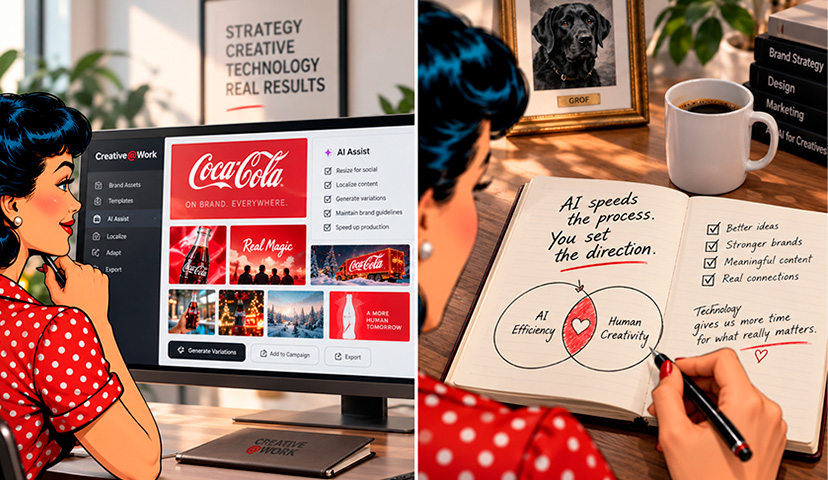
Coca-Cola describes Fizzion as a design-intelligence system that transforms traditional brand guidelines into adaptable assets, allowing teams across a global organization to create work more efficiently while maintaining brand integrity.
That distinction is crucial.
The human-created brand system comes first. AI helps operate it.
For a company with more than 200 brands operating across more than 200 countries, the potential efficiency is obvious: localization, adaptation, resizing, production variations and repetitive execution can consume enormous amounts of creative time.
This is exactly where AI can be brilliant.
Not:
“Design our brand.”
But:
“Help our designers apply this carefully designed brand system across hundreds of executions.”
There is a very big difference.
Case Two: When AI Becomes the Visible Creative Idea
Then came Coca-Cola’s AI-generated holiday advertising.
The company revisited its iconic “Holidays Are Coming” world using generative AI. The 2025 iteration reportedly involved around 100 people, including five AI specialists who generated and refined more than 70,000 video clips, with the production completed in roughly a month.
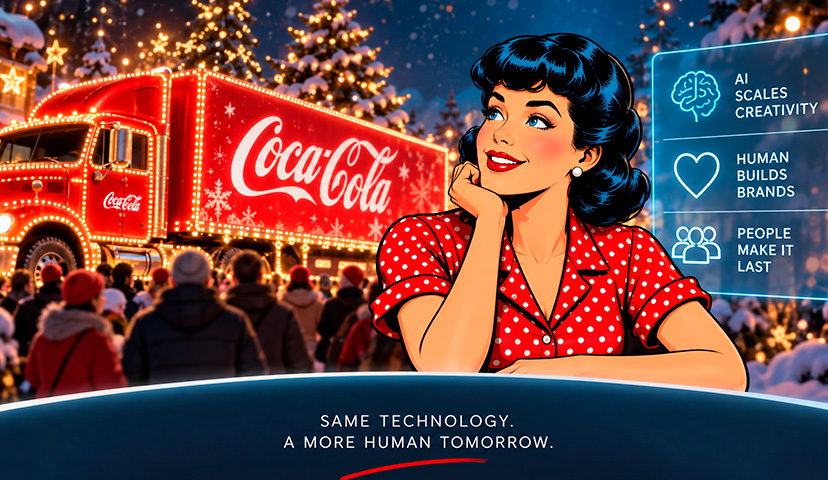
From a production-efficiency perspective, that’s remarkable.
From a branding perspective, the response became much more complicated.
Critics pointed to visual inconsistencies and described the work as lacking the warmth associated with Coca-Cola’s traditional Christmas advertising. Yet research cited around the campaign also indicated strong emotional performance among broader audiences, making this less of a simple “AI ad failed” story and more of a useful branding debate.
That nuance matters. The technology did something impressive. But consumers weren’t judging the technology. They were judging Coca-Cola.
And those are two entirely different standards.
Consumers Don’t Reward the Process. They Experience the Result.
This may be the most important principle for brands experimenting with AI.
A customer rarely cares that a campaign took:
- 30 days instead of six months,
- one designer instead of five,
- 50 prompts instead of three photo shoots,
- or half the previous production budget.
Those things matter enormously inside a business.
But outside the business, consumers experience only the result.
- Does it feel distinctive?
- Does it feel credible?
- Does it feel like the brand?
- Does it make me feel something?
- That last question becomes particularly important for brands built around emotion.
Coca-Cola isn’t really selling carbonated water, sugar and flavouring at Christmas.
It is selling ritual. Nostalgia. Anticipation. Family. The feeling that the holidays have arrived.
Technology therefore has to preserve something much harder than visual consistency:
emotional consistency.
Manual Design Isn’t About Refusing Technology
This is where the conversation about “manual design versus AI” often goes wrong.
Manual design does not mean rejecting AI. It means retaining human judgment.
A designer isn’t valuable because they can manually remove a background that AI can remove in seconds.
A brand strategist isn’t valuable because they can spend three hours resizing the same campaign into fifteen formats.
Those are precisely the kinds of jobs we should allow technology to accelerate.
Human creative value sits somewhere else.
It sits in deciding:
- what should be communicated,
- what should be removed,
- what feels wrong,
- what feels too generic,
- which idea is worth developing,
- when a design is technically correct but emotionally dead,
- and when the fastest solution isn’t the right solution.
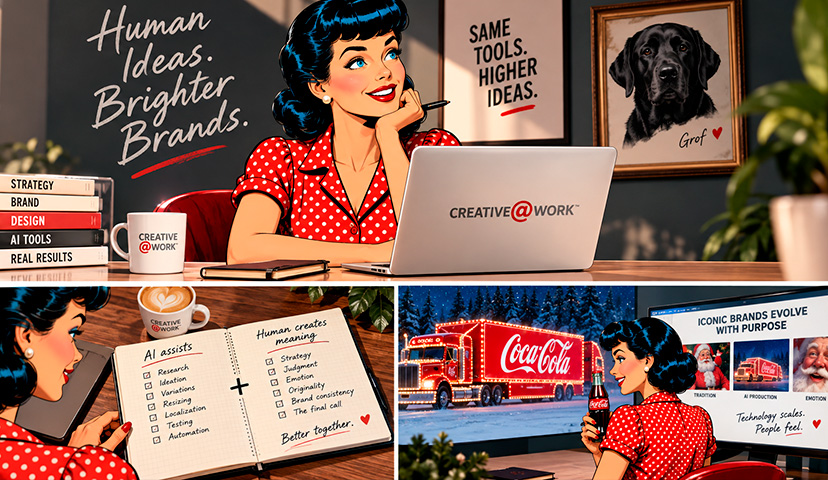
- AI can generate 100 options.
Someone still needs to know which option should never leave the studio.
That is creative judgment.
And it becomes more valuable — not less — when production becomes easier.
The Coming Branding Problem: Everything Can Look Good
There is another consequence of generative AI that businesses should pay attention to.
The baseline quality of marketing content is rising incredibly quickly.
Almost anyone can now produce:
- a polished photograph,
- a slick social post,
- a professional-looking presentation,
- a website layout,
- an advertising concept,
- or a plausible logo.
That sounds like wonderful news. It is. But it creates another problem.
If everyone can create something polished, polished is no longer differentiation.
The danger is not necessarily that AI will produce ugly design. The bigger danger is that it produces perfectly acceptable design.
Again. And again. And again.
Until brands begin looking strangely interchangeable.
- Same cinematic lighting.
- Same perfect product floating in space.
- Same gradients.
- Same fashionable typography.
- Same smiling AI people.
- Same “premium” minimalism.
- Technically impressive.
- Strategically anonymous.
Branding has never been about making something merely attractive.
It is about making something recognizable as yours.
So Where Should AI Actually Help a Creative Team?
There are plenty of places where AI can dramatically improve a modern branding and marketing workflow.
Research and discovery. AI can accelerate competitor scans, summarize large amounts of information and help teams identify patterns before deeper human analysis begins.
Early ideation. It can help explore unexpected visual territories, headlines, campaign routes and references much faster.
Production. Resizing, background extension, retouching, image cleanup, variations, localization and repetitive asset creation are obvious opportunities.
Content adaptation. One strong campaign idea can be adapted into social posts, website content, email concepts, presentation material and other formats far more efficiently.
Testing. Teams can create more variations for experimentation without multiplying production costs.
Administration. Brief summaries, meeting notes, first-draft documentation and routine organization can free substantial time.
And that saved time can go somewhere more valuable:
thinking.
That, to me, is the interesting promise of AI for creative businesses.
Not fewer ideas. More time for better ones.
Search Is Changing Too — and This Matters for Brands
The same shift is happening beyond design.
How customers discover businesses is changing.
Google’s AI Overviews and AI Mode now answer increasingly complex questions directly, and Google’s own guidance says websites do not need some mysterious new “AI SEO” technique to participate. Existing SEO fundamentals still matter: crawlability, internal linking, useful text, good page experience, high-quality media and structured data that accurately reflects the visible page.
In June 2026, Google reported more than 2.5 billion monthly active users for AI Overviews and more than one billion for AI Mode. blog.google
This changes what good brand content needs to do.
A website can no longer exist simply to repeat:
“We are innovative.”
“We provide high-quality solutions.”
“We put customers first.”
Thousands of companies say exactly the same things.
For both traditional SEO and AI-assisted discovery, businesses increasingly need content that demonstrates actual expertise, answers real questions and provides information worth citing.
Google explicitly recommends people-first content demonstrating first-hand expertise and warns against producing large volumes of automated material that adds little original value.
Interestingly, that brings us back to exactly the same conclusion as design.
AI can help create content. Human experience is what gives the content a reason to exist.
What Smaller Brands Can Learn From Coca-Cola
Most businesses do not have Coca-Cola’s budgets, archives or global marketing infrastructure.
But the principle scales surprisingly well. Before asking AI to produce more content, build the brand system it should work within.
- Define the visual language.
- Define the voice.
- Define what your brand would never say.
- Define what your photography should feel like.
- Define typography.
- Define composition.
- Define the emotional territory.
- Define what makes the company recognizably different from competitors.
- Then use AI to accelerate that system.
Without those decisions, AI isn’t amplifying your brand. It is improvising one.
And every new prompt may improvise a slightly different version.
That is not brand building. That is content production.
Human First. AI Where It Earns Its Place.
There is no convincing argument for returning to a slower creative industry simply because slower feels more traditional.
- We should automate repetitive work.
- We should use better tools.
- We should explore faster.
- We should prototype more ideas.
- We should remove unnecessary production time wherever possible.
But efficiency should buy us more room for judgment, not eliminate judgment altogether.
Coca-Cola’s experiments illustrate both sides beautifully.
- AI behind a strong brand system can help a global organization scale creativity.
- AI placed at the emotional centre of a beloved brand can trigger a completely different conversation.
The lesson isn’t that brands should avoid AI.
It’s more useful than that:
Let AI do what machines are becoming exceptionally good at, so humans have more time to do what brands still desperately need — think, choose, edit, feel and create meaning.
Because the future of branding probably isn’t human or AI. It is human judgment deciding exactly where AI belongs. And knowing when it doesn’t.
Quick FAQ
Will AI replace graphic designers?
AI is already automating parts of design production, but brand strategy, art direction, taste, context and final creative judgment remain fundamentally different from asset generation. The role is likely to shift toward directing, curating and building stronger creative systems.
Is AI-generated content bad for SEO?
Not automatically. Google’s guidance focuses on the quality, accuracy, relevance and usefulness of content rather than whether AI assisted in producing it. Scaled automated content created primarily to manipulate rankings can violate Google’s spam policies.
What is GEO in marketing?
Generative Engine Optimization, commonly called GEO, is the practice of structuring useful, authoritative and clearly contextualized information so that AI-powered discovery systems can understand and potentially surface or cite it. For Google specifically, the company says its existing SEO fundamentals remain relevant to AI Overviews and AI Mode and that no special AI schema is required.
Where should a small business start with AI?
Start with repetitive, low-risk work: research assistance, brainstorming, resizing, image cleanup, content adaptation and first drafts. Keep brand positioning, strategic decisions, final copy, visual direction and quality control human-led.
Let’s put these ideas to work on your brand.