

Why brand clarity, web design and structured expertise matter more in the age of AI search
For years, businesses designed websites around two questions:
- Will people understand us?
- Will Google find us?
In 2026, there is a third:
Will AI understand who we are well enough to recommend us?
This is no longer theoretical.
Google introduced dedicated Search Generative AI performance reports in Search Console in June 2026, and as of August 31, 2026, those insights were rolled out to all websites worldwide. The reports include visibility in generative AI Search features such as AI Overviews and AI Mode.
That is an important signal.
Visibility is no longer only about ranking as a traditional blue link.
Brands increasingly need to be clear enough to be understood, credible enough to be trusted and useful enough to be surfaced in AI-generated answers.
Brand Clarity Is Becoming a Search Advantage
Many websites still sound almost identical:
- “We provide innovative solutions.”
- “We are passionate about excellence.”
- “We tailor our services to your needs.”
Nothing is technically wrong with those statements.
They are simply too generic.
A strong website should make it immediately clear:
- what the company does
- who it serves
- what problems it solves
- what makes it different
- what expertise supports those claims
Brand differentiation is becoming machine-readable differentiation.
That may sound technical, but it is fundamentally a branding issue.
GEO Does Not Replace SEO
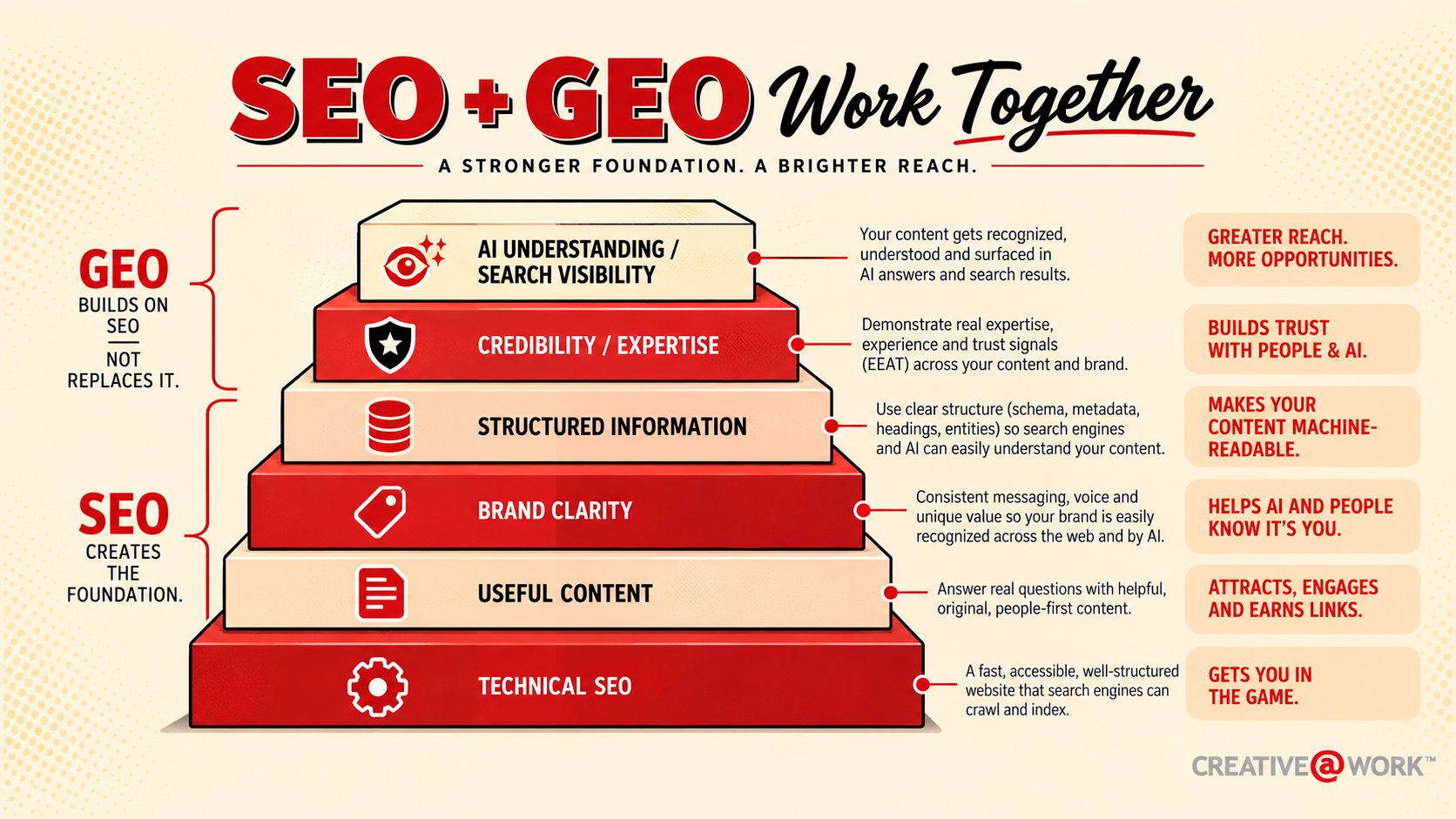
Generative Engine Optimization — GEO — is one of the newest marketing acronyms.
But Google’s guidance is surprisingly straightforward.
SEO fundamentals still matter.
Google specifically emphasizes valuable, unique, non-commodity content, people-first information and real expertise. It also says traditional SEO best practices remain foundational for generative AI Search.
So GEO should not be treated as a collection of tricks.
Good GEO still depends on:
- useful content
- clear structure
- strong internal linking
- technical SEO
- consistent terminology
- credible authorship
- real expertise
The question is not:
“How do we get AI to mention us?”
The better question is:
“Are we publishing something useful enough to deserve being referenced?”
Your Website Is Becoming a Knowledge Base
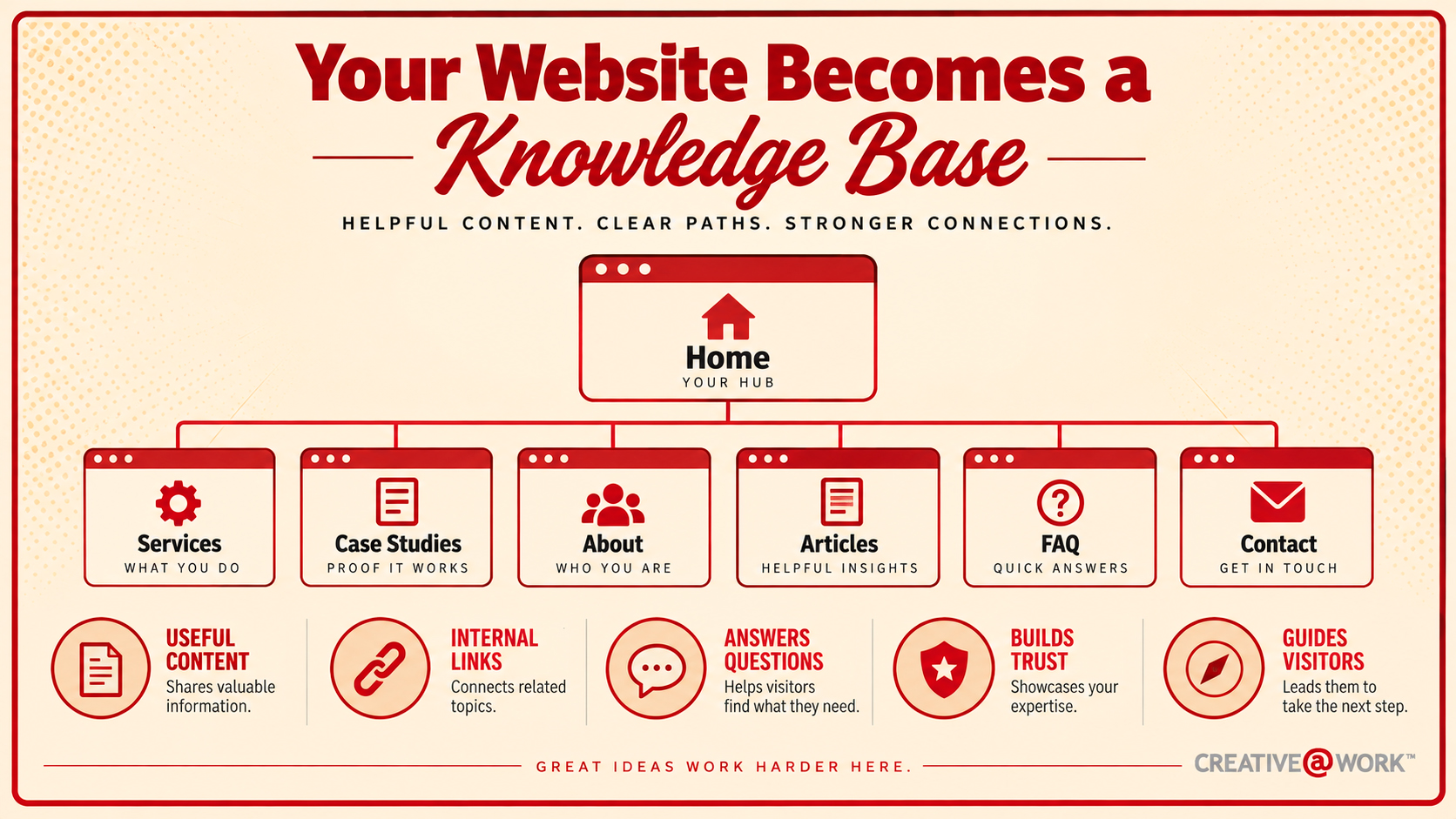
The old company website was often:
Home. About. Services. Contact.
That is becoming less effective.
A modern website should increasingly work as a structured source of knowledge about the business.
Service pages should explain what you actually do.
Case studies should show the problem, process and outcome.
About pages should establish experience and credibility.
Articles should demonstrate real thinking, not simply repeat generic industry advice.
FAQs should answer real customer questions.
And the whole website should use:
- clear headings
- useful internal links
- consistent service terminology
- descriptive image alt text
- structured content
That helps SEO.
It helps AI systems understand the site.
And it helps humans make faster decisions.
Design Still Matters
If machines are reading websites, does visual design matter less?
No.
AI may help someone discover you.
A human still decides whether they trust you.
Visitors notice:
- hierarchy
- typography
- navigation
- visual consistency
- image quality
- clarity
- how quickly they understand the offer
Good web design is not decoration around SEO content.
It is how positioning becomes visible.
SEO may earn the visit. Design helps earn the confidence.
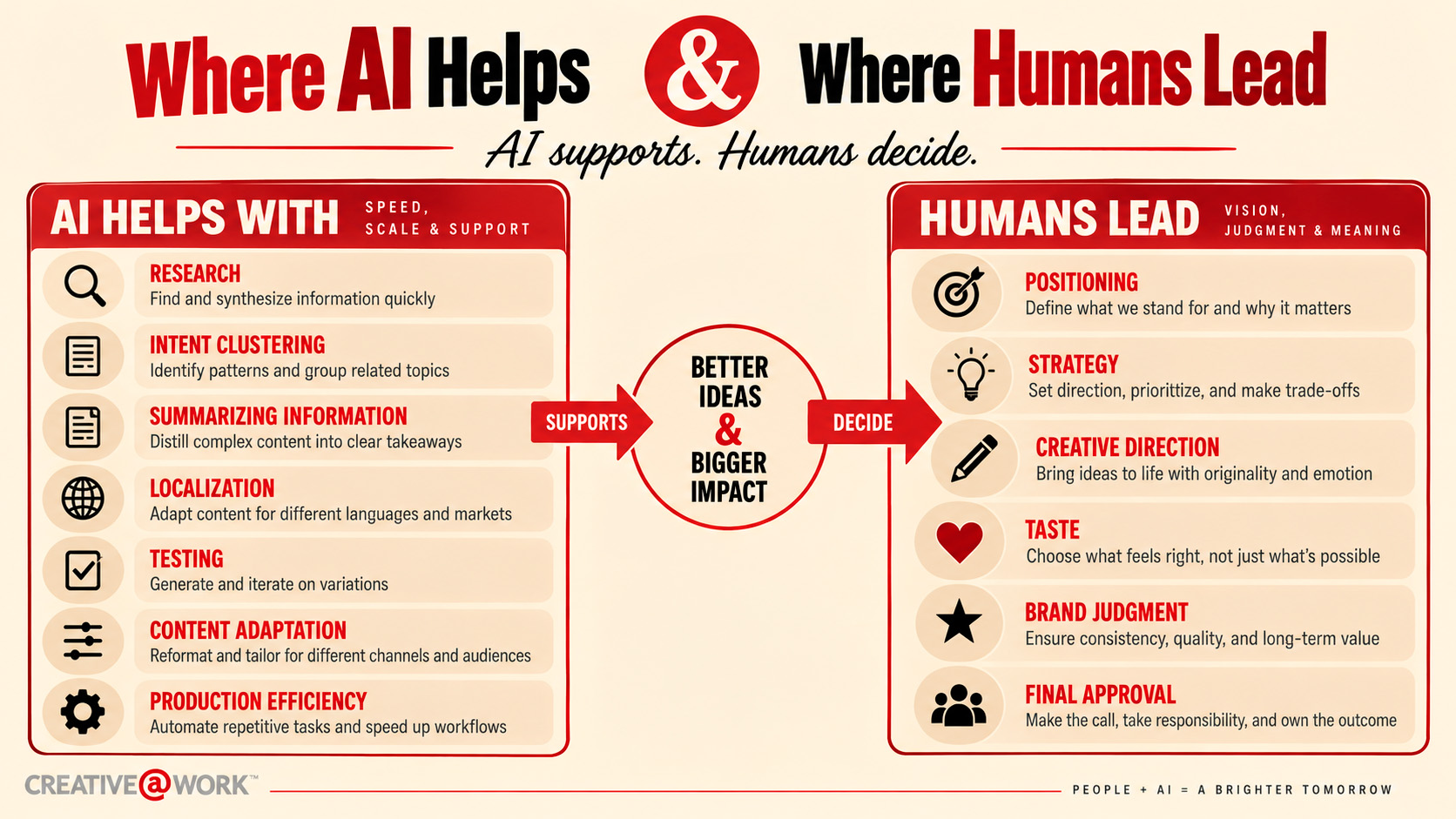
Where AI Should Actually Help
AI can save serious time in areas such as:
- competitor research
- search-intent analysis
- content-gap research
- summarizing large amounts of information
- localization
- resizing and adaptation
- testing variations
- repetitive production
That is useful.
But humans still need to decide:
- which insight matters
- which idea fits the brand
- what sounds authentic
- what deserves emphasis
- what should never be published
AI should shorten the distance between information and decision. It should not replace the decision.
The Sameness Problem
AI is making polished execution easier.
That creates a new risk:
Everything can start to look equally polished.
The same layouts.
The same gradients.
The same generic photography.
The same “premium” minimalism.
When execution becomes easier, distinctiveness becomes more valuable.
That is where human creative direction still matters.
Not because every pixel must be made manually.
But because someone has to decide:
- which conventions to follow
- which ones to break
- how the brand should feel
- what visual choices make it recognizable
AI can help execute a visual system. Human judgment creates the system.
What Smaller Businesses Should Do Now
You do not need a complicated AI strategy.
You need clarity.
Ask:
- Can someone understand what we do within 10 seconds?
- Are our service pages genuinely useful?
- Does our About page show real experience?
- Does our content say something original?
- Does every page feel like the same brand?
- Are we using AI to save time — or simply to create more content?
Then use AI where it creates leverage.
Let AI:
- research
- summarize
- compare
- adapt
- accelerate
Keep people responsible for:
- positioning
- strategy
- taste
- creative direction
- final approval
The New Competitive Advantage Is Clarity
Search is changing.
AI search is changing how information is surfaced.
But the strategic requirement remains familiar:
- Be useful.
- Be specific.
- Be recognizable.
- Demonstrate expertise.
- Create something worth remembering.
Google’s people-first guidance still emphasizes original, useful and trustworthy content created for users rather than for ranking manipulation.
The internet does not need more content. It needs more identifiable expertise.
The goal is not to build websites for machines.
It is to build brands so clear that both machines and people understand why they matter.
Quick Takeaway
- GEO builds on SEO; it does not replace it.
- Brand clarity helps both humans and AI understand a business.
- Your website should act like a knowledge base, not just a brochure.
- AI is excellent for research and production efficiency.
- Human judgment still creates differentiation and trust.
Let’s put these ideas to work on your brand.