
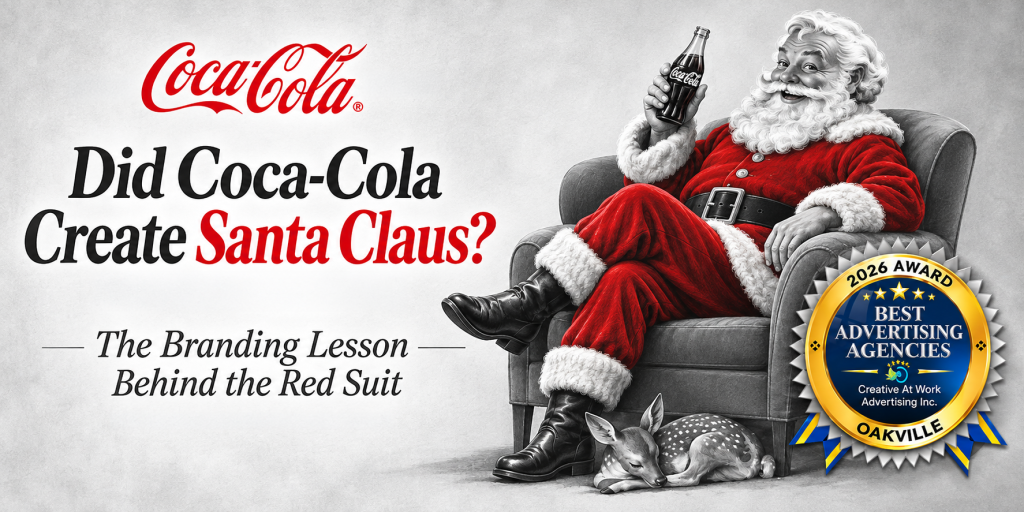
The man in the red suit and cap, with the thick black belt, sooty boots, and rosy cheeks. Ask almost anyone to picture Santa Claus, and that’s the image they see. Many people believe this Santa was born in a Coca-Cola advertising campaign. The truth is more interesting, and it holds one of the best branding lessons of all time.
Did Coca-Cola Really Create Santa Claus?
Not exactly. Cartoonist Thomas Nast drew Santa for 30 years in the 1800s, gradually changing his coat from tan to red. By the end of the 1920s, a standard American Santa in a red, fur-trimmed suit had already emerged. Even Coca-Cola itself admits it: the company’s website notes that Santa appeared in a red coat before its artist painted him. Haddon Sundblom and the Coca‑Cola Santas +2
So where did the myth come from? In 1931, Coca-Cola wanted more people to drink Coke during the holidays, so it hired Michigan-born illustrator Haddon Sundblom. Sundblom drew inspiration from Clement Clarke Moore’s 1822 poem “A Visit From St. Nicholas,” better known as “ ’Twas the Night Before Christmas.”
His Santa was warm, jolly, and human. It debuted in Coca-Cola ads in The Saturday Evening Post and appeared regularly in magazines such as Ladies’ Home Journal, National Geographic, and The New Yorker.
How the Coca-Cola Santa Claus Became a Global Icon
Coca-Cola didn’t invent Santa. Instead, it did something more powerful: it made one version of him impossible to forget.
From 1931 to 1964, Coca-Cola ads showed Santa delivering toys, pausing to read letters, enjoying a Coke, and visiting children. Year after year, the same face appeared in the same red suit, in the most popular magazines of the day. As a result, the Coca-Cola Santa Claus became the Santa for millions of people around the world.
Before Sundblom, Santa’s suit had appeared in blue, yellow, green and even black. After his version took hold, only a red-wearing Santa would fit the bill. Of course, it helped that the red and white suit matched Coca-Cola’s own brand colours perfectly.
Brands Still Use Santa as Leverage Today
Nearly a century later, brands still borrow Santa to capture attention at Christmas. The most recent example comes from Marks & Spencer.
In its 2026 Christmas advert, “The Home of Christmas,” M&S cast James Norton as an incognito Santa, with Lucy Punch as Mrs Claus. In the film, Santa swaps his red suit for a Christmas jumper, shaves off his beard, and heads out into the world to experience Christmas from a new perspective. Without the beard, nobody recognises him, so he heads to London to enjoy the Christmas he usually spends delivering presents.
The idea is clever. M&S uses the most recognisable character in the world, then surprises us by taking away the very features that make him recognisable. The campaign also brings the retailer’s Fashion, Home, Beauty and Food businesses together in a single campaign. In other words, Santa becomes the thread that ties the whole brand together. esmmagazine
4 Branding Lessons From the Coca-Cola Santa Claus
- Consistency beats creativity alone.
Coca-Cola used the same Santa for more than 30 years. Repetition turned an illustration into a cultural icon. Your brand works the same way: the more consistently people see it, the more they remember it. - Own your colours.
Red and white are now linked to both Coca-Cola and Christmas. A strong, consistent colour palette helps customers recognise you instantly. - Connect your brand to emotion and tradition.
Coca-Cola didn’t sell a drink. It sold warmth, joy, and family moments. When your brand becomes part of a ritual, customers come back to it every year. - Borrow icons, but add your own twist.
M&S didn’t just show Santa. It gave him a surprising new story. If you use a familiar symbol, make sure your version is unmistakably yours.
What This Means for Your Business
You don’t need Coca-Cola’s budget to apply these lessons. You need a clear identity, a consistent look, and the patience to repeat your message until people know it by heart.
Want to build a brand people recognise at first glance? Get a quote, and let’s create a brand identity that stands the test of time.
Let’s put these ideas to work on your brand.